


Last Updated: November 17, 2026
Quick Summary
A useful corner standing desk comparison measures stability at full height, the true height range, load capacity including the desktop, motor quality and the guarantee length. Check return orientation and footprint against your room before ordering, because a handed desk cannot be flipped after delivery.
- Electric adjustment suits corner setups because a large, loaded desk is moved far more often.
- A three-leg corner frame distributes load better than a two-leg frame spanning the same area.
- The Stockholm Signature lowers to 595 mm and raises to 1.3 metres using dual motors.
- Divide the price by the guarantee years to compare total ownership cost fairly.
- Confirm left or right return orientation in the room before ordering a handed desk.
Table of Contents
- What a Corner Standing Desk Comparison Should Actually Measure
- Electric Standing Desk vs Manual Desk: Which Adjustment Suits a Corner Setup
- Electric Standing Desk Stability: What Wobble Testing Reveals at Full Height
- L-Shaped Standing Desk Dimensions and Room Fit
- Standing Desk Weight Capacity and Frame Construction
- Height Range, Motors and Controls Compared
- Total Ownership Cost and Warranty Comparison
- Choosing Your Corner Desk Configuration
- Frequently Asked Questions
What a Corner Standing Desk Comparison Should Actually Measure
An electric corner standing desk comparison is only useful if it measures the things that change how a desk behaves in daily use: stability at full height, the true height range, load capacity, motor quality, and what happens when something goes wrong in year three. This guide from FRISKA DESK sets out what to check, and why most spec sheets quietly avoid the hard numbers.
Most buyers start with a spreadsheet of dimensions and prices. That spreadsheet will not tell you whether the desk shakes when you type at standing height, or whether the frame will still be rigid after five years of daily raising and lowering.
Below, we break down the criteria that actually separate a good corner standing desk from a wobbly one, including room fit, return orientation, motor performance and total ownership cost. The aim is simple: give you a repeatable way to judge any desk you are considering.
Why a Like-for-Like Comparison Beats a Spec Sheet
Spec sheets are written to be compared on paper, not in a room. Two desks can both claim a 1,300 mm maximum height and a 120 kg load, yet behave completely differently once a monitor arm and a pair of speakers are sitting on top.
A genuine like-for-like comparison fixes the variables. Same load, same height, same task. Then it asks: does the work surface move when the keyboard is used? Does the monitor wobble when the desk is nudged? Does the frame creak at the top of its travel?
HSE guidance on display screen equipment makes the point that workstation setup should suit the individual user, which is hard to judge from a spec table alone. A desk that measures well but flexes under a light typing load will not deliver the posture benefits it promises.
For a worked example of how two same-category desks can be compared fairly, this direct brand comparison shows the method in practice: matched load, matched height, matched task.
Electric Standing Desk vs Manual Desk: Which Adjustment Suits a Corner Setup
Electric adjustment wins for corner setups in almost every case, because a corner desk is large and often loaded with two work zones. Manual winding or pin-adjustment desks are cheaper, but they are slower to change and far less likely to be adjusted often enough to matter.
The practical difference comes down to friction. An electric sit-stand desk moves between seated and standing height at the touch of a button, while a manual desk requires winding, which adds friction to changing position.
Where manual still makes sense: a fixed-height desk in a spare room, or a budget setup where the desk will rarely move. For anyone intending to alternate sitting and standing daily, electric is the practical choice.
Electric Standing Desk Stability: What Wobble Testing Reveals at Full Height
Electric standing desk stability is where most comparisons fall apart, because wobble is rarely measured and almost never published. A desk can feel solid at 900 mm and noticeably shaky at 1,300 mm, and that gap matters most for taller users.
What separates stable frames from unstable ones:
- Foot depth and footprint. Longer feet resist front-to-back rocking. A corner desk needs a deep main foot plus a shorter return leg.
- Steel gauge and weld quality. Thicker tube walls and tighter tolerances reduce flex at the joints.
- Fixings between frame and desktop. Pre-drilled metal screw inserts create a rigid bond; screws straight into chipboard work loose.
- Number of legs and lifting columns. A corner frame with three legs distributes load better than a two-leg frame spanning the same area.
Watch out: a desk that wobbles at full height is not just annoying. It pushes users to lower the desk and sit more, which defeats the purpose of buying it.
For a deeper look at diagnosing and fixing movement at height, this guide to standing desk stability issues covers the causes and the fixes.
L-Shaped Standing Desk Dimensions and Room Fit
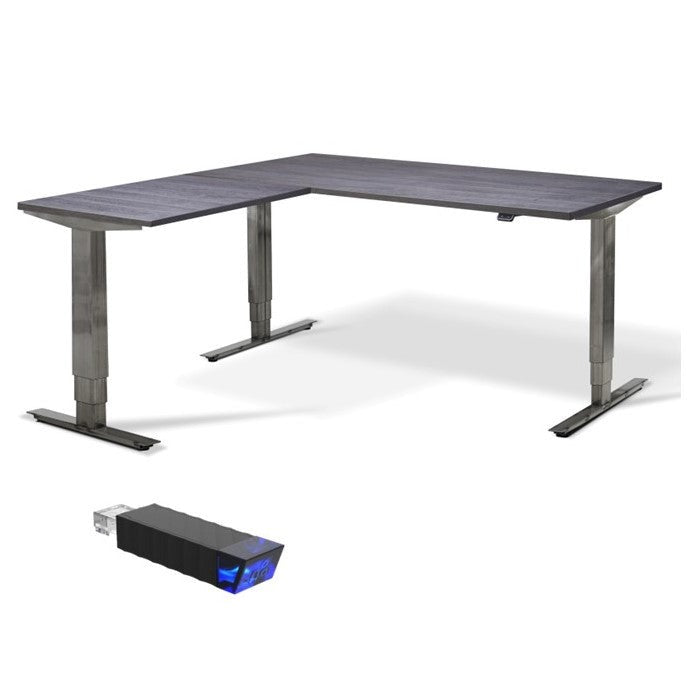
L-shaped standing desk dimensions decide whether the desk works in your room before any other specification matters. A corner desk is built in two sections, and the return is what eats floor space.
Corner desks are built in two sections, a main desk and a return. Check the dimensions of the specific model you are considering before measuring your room. Check the total footprint against your room, not just the main desk width.
Measure three things before ordering:
- Wall run available for the main section, including clearance for skirting boards.
- Return depth into the room, and whether a door, radiator or window restricts it.
- Footprint of the feet, which is usually deeper than the desktop above them.
Left-Hand Versus Right-Hand Return Orientation
Return orientation is the detail buyers most often get wrong. A left-hand return puts the side section on your left as you sit at the main desk; a right-hand return mirrors it.
Get it wrong and the desk will not fit the corner you bought it for. Decide orientation by standing in the room and asking which side you want your secondary work zone, monitor or printer on. Then confirm the desk can be configured that way, because many corner desks are handed and cannot be flipped after delivery.
Standing Desk Weight Capacity and Frame Construction
Standing desk weight capacity is usually quoted generously, and that is fine, because most users never approach it. What matters more is how the frame is built to carry the load it claims.
The Stockholm Signature corner desk is rated to 120 kg including the desktop, which comfortably covers most professional setups. The number to check is whether the desktop is included in the figure, since some brands quote frame-only capacity.
Frame construction tells you more than the load figure:
- Steel grade and recycled content. Frames built from higher-grade steel hold rigidity better over years of use.
- Lifting columns. Three-stage columns give a wider height range from a shorter collapsed frame.
- Cross-bracing and support arms. Under-desk support arms spread the load across the desktop and reduce sag on long spans.
- Weight of the frame itself. A heavier frame is usually a stiffer frame.
Height Range, Motors and Controls Compared
Height range is the specification that decides whether a desk suits its user, and it should be checked at both ends. The Stockholm Signature corner desk lowers to 595 mm and raises to 1.3 metres.
The Stockholm Signature uses dual motors for speedy yet whisper-quiet raising and lowering.
The Stockholm Signature offers both physical controls and Bluetooth app control, with an app-adjustable anti-collision sensor.
EU machinery safety requirements for height-adjustable furniture sets out that the operator should maintain contact with the control during movement, which is why reputable electric desks use press-and-hold switches rather than one-touch operation.
If you want to understand what actually goes wrong with motors and how to spot early warning signs, this guide to motor failure and diagnosis is worth reading before you buy.
Total Ownership Cost and Warranty Comparison
Total ownership cost is the number most comparisons leave out. The purchase price is only the first line; the guarantee length, replacement part costs and delivery terms decide what the desk really costs over a decade.
A useful way to compare is to divide the price by the guarantee years. The Stockholm Signature corner desk is priced at £1,165 and carries a 10-year guarantee.
Warranty terms deserve a close read. Look for:
- Motors and electrics included, not just the frame.
- Repair or replace, with parts shipped rather than a return-to-base process.
- Response times, since a desk out of action is a workspace out of action.
- Transferability, which matters for office buyers.
Citizens Advice guidance on consumer rights for faulty goods explains the statutory protections that sit underneath any manufacturer guarantee, which is useful context when comparing warranty claims.
For a fuller breakdown of whether the electric upgrade justifies its price, this analysis of electric standing desk value works through the cost case.
Choosing Your Corner Desk Configuration
Configuration is the last decision and the one that determines whether the desk fits your room and your working day. Work through it in a fixed order so nothing gets missed.
| Decision | What to Check | Why It Matters |
|---|---|---|
| Return orientation | Left or right, measured in the room | A handed desk cannot be flipped after delivery |
| Desktop size | Main width 160 cm or 180 cm, return 160 cm total | Determines wall run and floor space used |
| Height range | Lowest and highest working surface height | Must suit the shortest and tallest user |
| Load capacity | Figure including the desktop | Prevents overload and frame flex |
| Motors and controls | Dual motor, memory presets, app option | Affects daily ease of use and noise |
| Guarantee | Years covered, motors included | Drives total ownership cost |
| Delivery and install | Lead time, pallet delivery, installation option | Corner desks are heavy and awkward alone |
The FRISKA DESK Stockholm Signature corner desk, at £1,165, has a Swedish-engineered frame, a height range from 595 mm to 1,300 mm, a 120 kg load including the desktop, and a 10-year guarantee. It is also available as a bundle with a cable tray, Kubbe Memory Controller and cable ports at £1,295.
For buyers who have weighed the criteria and want to see the actual product, the Stockholm Signature corner desk lists the full specification, finishes and configuration options.
Comparing corner desks properly takes time, and it helps to check the dimensions, load and guarantee before you buy. FRISKA DESK builds Swedish-engineered standing desks with a height range from 595 mm to 1,300 mm and a 10-year guarantee. Start with the configuration checklist above, then get started with FRISKA DESK and specify a corner desk that fits your room and your working day.
Frequently Asked Questions
Are electric corner standing desks stable at standing height?
Stability comes down to frame steel, foot depth and how tightly the fixings are engineered. A well-built corner standing desk moves a fraction if you deliberately push it at full height but stays still during typing and normal use. Cheaper imports often wobble badly because of thin steel and loose tolerances.
How much space do you need for an L-shaped standing desk?
Plan around the desktop footprint plus clearance to raise and lower it. A typical corner model uses a 160 cm or 180 cm wide main section at 80 cm deep, with a 60 cm deep return running 160 cm along the side. Measure the corner wall run first, then confirm you can still reach the far edge of the return without stretching. Leave room for the desk to travel through its full height range without hitting shelving or a windowsill.
How much weight can an electric corner standing desk support?
It varies widely. The Stockholm Signature corner desk is rated to 120 kg including the desktop. If you run heavy equipment or a multi-screen trading setup, compare weight capacity against your actual load rather than assuming every frame is the same.
Is an electric standing desk better than a manual desk?
For a corner setup, electric adjustment wins on practicality. Dual motors on the Stockholm Signature make for speedy yet whisper-quiet raising and lowering, and you can pre-set your preferred sitting and standing height in the app. Manual desks are cheaper but slow to change and awkward to adjust with a loaded corner work surface. The trade-off is price and a mains connection, so weigh that against how often you will actually change posture.
