


Quick Summary
Sustainable office furniture for home means desks and chairs made from responsibly sourced materials, built to last, and easy to repair or pass on. Choose solid or reclaimed timber for durability and character, or melamine faced chipboard for a low-maintenance finish, and check warranties and spare parts before buying.
- A piece lasting a decade costs less per year than one replaced every two or three years.
- Check whether the chipboard uses recycled or sustainably sourced wood and holds FSC certification.
- Lift and lower any second-hand adjustable desk through its full range before buying.
- Set standing height so your elbows sit at about 90 degrees with wrists kept straight.
- Choose a frame with a long guarantee and replaceable parts, as it usually costs less per year.
Table of Contents
- Why Sustainable Office Furniture Matters for a Home Workspace
- Sustainable Office Furniture Materials That Last
- Buying Second-Hand Office Furniture Without Compromising Quality
- Building an Ergonomic Home Office Setup Around Your Desk
- Why a Standing Desk for Home Office Use Can Be the Most Sustainable Choice
- Checking Warranties, Repairs and End-of-Life Options
- Choosing Your Sustainable Desk Before You Order
- Frequently Asked Questions
Why Sustainable Office Furniture Matters for a Home Workspace
Last Updated: 7 November 2026
Sustainable office furniture for home use means desks and chairs built from responsibly sourced materials, designed to last, and easy to repair or pass on. For UK remote workers, the choice affects more than the planet. A desk you use eight hours a day shapes your posture, your circulation and your back.
A piece of furniture that lasts a decade costs less per year than one replaced every two or three years. Long-lasting pieces also keep materials out of landfill for longer. When you buy sustainable office furniture for home, you are choosing durability first and environmental impact second, which in practice tend to point the same way.
Home workspaces create a particular challenge. Furniture bought for a shared office often gets a short working life once it moves into a spare bedroom or a corner of the living room. Pieces that can be adjusted, repaired and reused suit that changing setup much better than fixed, disposable units.
Sustainable Office Furniture Materials That Last
Material choice does most of the work in making home office furniture sustainable. Solid timber, reclaimed wood and high-quality engineered boards each carry a different balance of durability, cost and environmental footprint.
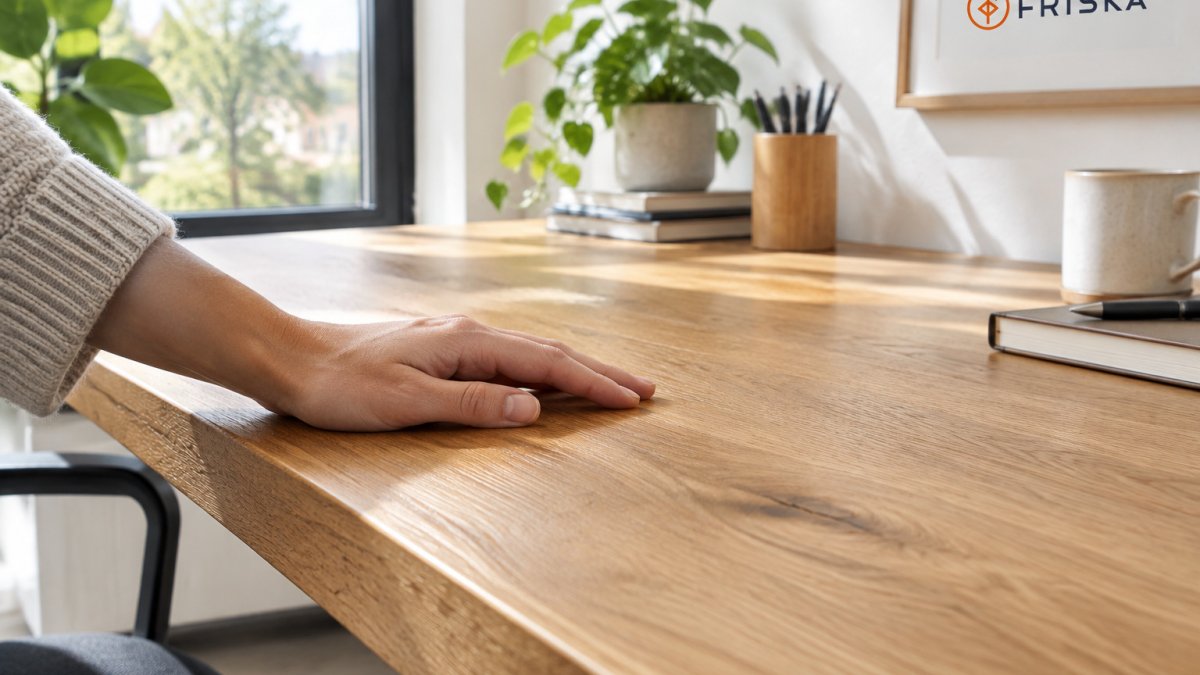
!Close-up of a hand resting on a natural solid oak desktop with visible wood grain in a bright home office
Solid Wood and Reclaimed Timber
Solid wood and reclaimed timber are widely used options for a desktop. The Reclaimed Scaffold Board Desktops are made from genuine reclaimed boards, finished with a matt lacquer, and sold as a desktop only at £315.00.

Solid oak offers a different look and feel. The Character Oak Solid Desktops feature natural knots and grain variation and are priced from £415.83 for the desktop alone.

Solid wood moves with changes in humidity, so expect slight warping or splitting over time. Keeping a desk away from direct heat sources and damp conditions helps. How to Seal a Solid Wood Desk Top So It Lasts explains how to protect the surface so it stays in good condition for longer.
UK government guidance on sustainable procurement and timber sourcing
Melamine Faced Chipboard and Recycled Content
Melamine faced chipboard, often shortened to MFC, is a common core for office desks. The surface is a hard, thin melamine layer bonded to a chipboard core.
When comparing options, check whether the chipboard uses recycled or sustainably sourced wood, and whether the manufacturer holds Forest Stewardship Council (FSC) certification. Ask for samples before buying, since the finish and feel differ between suppliers. FRISKA DESK offers free desktop finish samples, so you can test a surface in your own room before you commit.
Buying Second-Hand Office Furniture Without Compromising Quality
Second-hand office furniture is one of the most sustainable choices available, as it keeps good products in use. The main risks are hidden wear, outdated mechanisms and missing parts.
Check the frame before the surface. Lift and lower any adjustable desk through its full range, listening for grinding or uneven movement. Look for cracks around fixings and inspect the underside of the desktop for water damage or delamination.
Ask the seller for the make, model and date of purchase. Many manufacturers publish specifications that help you confirm the weight rating and compatibility with replacement parts. If the seller cannot provide details, treat that as a warning sign.
Building an Ergonomic Home Office Setup Around Your Desk
A sustainable desk only helps if it supports good posture, and posture is easier to get right when you work from measurements rather than guesswork. The sequence below starts with your own body and the shoes you actually wear, then adjusts the desk, screen and peripherals around that. It is a more reliable method than copying a height chart, because arm length, torso length and footwear all shift the correct number.
Step 1: Set the standing height from your elbow, not a chart
Stand in the shoes you normally wear at the desk, trainers, slippers or bare feet all change your standing height by 10 to 30 mm, which is enough to matter. Let your arms hang relaxed, then bend your elbows to roughly 90 degrees.
Measure from the floor to the top of the desk surface, not to the frame. If your keyboard is thick, add its height to the target: a desk set at elbow height with a 30 mm keyboard on top effectively raises your hands by 30 mm.
Step 2: Check elbow angle and wrist alignment
With your hands on the keyboard, your elbows should sit at about 90 to 100 degrees, with your upper arms close to your sides. Your wrists should be straight, not bent upwards or dropped downwards, and your shoulders should be relaxed rather than lifted towards your ears.
Watch out: if your shoulders creep up, the desk is usually too high; if your wrists bend upwards to reach the keys, the desk or keyboard is too high; if you lean forward to reach the keys, the desk is too far away or too low.
Step 3: Position the monitor for height and distance
Set the screen roughly an arm's length away, about 500 to 700 mm for most people, and adjust the top of the screen to sit near eye level, so your gaze drops slightly when you read. If you wear varifocals, you may need the screen lower to avoid tilting your head back.
A laptop on its own forces a compromise: the screen sits too low for your neck or the keyboard sits too high for your arms. The fix is a laptop stand plus a separate keyboard and mouse, so the screen can rise to eye level while your hands stay at elbow height.
Step 4: Set the sitting height and switch between the two
Lower the desk until your elbows are again at roughly 90 degrees with your feet flat on the floor. If your feet do not reach the floor, use a footrest rather than lowering the desk further, which would push your knees above your hips.
Alternate between sitting and standing rather than treating standing as a posture to hold all day. A common pattern is to stand for 20 to 30 minutes in each hour and sit for the rest, adjusting as your comfort dictates. Standing for long stretches without moving can cause its own stiffness.
Step 5: Troubleshoot discomfort
Most typing discomfort maps to a small number of fixes. Raised shoulders point to a desk that is too high. Bent wrists point to a keyboard that is too thick or angled.
A 7 Steps to Set Standing Desk Height for Typing guide walks through the measurements in more detail, and the full How to Set Up an Ergonomic Home Office in 2026 guide covers the rest of the workspace, including lighting and chair setup.
NHS advice on posture and working from home
The steps below set out the key measurements and checks for a comfortable home desk, so you can work from your own body rather than a generic chart.
| Step | What to do | Time or measure |
|---|---|---|
| Set standing height | Stand in your usual shoes and bend elbows to about 90 degrees | Elbows at 90 degrees |
| Check elbows and wrists | Keep wrists straight and shoulders relaxed while typing | Elbows at 90 to 100 degrees |
| Position the monitor | Place the screen about an arm's length away, near eye level | About 500 to 700 mm |
| Set sitting height | Lower the desk until feet are flat and elbows still bend at about 90 degrees | Feet flat on floor |
| Alternate positions | Stand and sit in turns rather than standing all day | Stand 20 to 30 minutes each hour |
| Troubleshoot discomfort | Match the symptom to the fix, and see a GP if pain persists | Review after adjustments |
Why a Standing Desk for Home Office Use Can Be the Most Sustainable Choice
A height-adjustable desk earns its sustainability case through use, not through materials alone.
The Mora Single Motor Height Adjustable Standing Desk illustrates the practical details to check.
Three features matter most for longevity. First, check the height range against your own measurements: if your standing elbow height falls near the top of the range, you will have little headroom for a thicker desktop or a standing mat. Second, ask whether the frame accepts a different desktop later, replacing only the surface is far more sustainable than replacing the whole desk, and it lets you move from MFC to solid timber without buying a new frame. Third, confirm that motors, control panels and feet are available as separate parts, because a desk you can repair is a desk you keep.
Adjustability also supports the posture advice above. Being able to set and save both a sitting and a standing height makes alternating between them practical, which is the pattern most practitioners recommend rather than standing continuously.
When comparing frames, look beyond the headline price to the guarantee terms, the spare-parts policy and the weight rating.
Checking Warranties, Repairs and End-of-Life Options
Warranty length says a lot about expected lifespan. FRISKA DESK supports its products with a 10-year guarantee on the desktop finishes and a 7-year guarantee on the Mora frame components. Before buying any office furniture, read the warranty terms and find out what is covered.
Repairability matters too. Check whether replacement parts, such as motors, control panels or feet, are available separately. A desk you can repair is a desk you keep.
At the end of its life, a desk made of solid wood can often be reused, refinished or passed on. Chipboard and MFC are harder to recycle, so check local council or retailer take-back schemes before disposal.
Waste and Resources Action Programme guidance on furniture reuse
Choosing Your Sustainable Desk Before You Order
Start with the space. Measure the room and the position of windows, sockets and doors.
Decide on the material next. Solid wood suits buyers who value character and are happy to maintain the surface. MFC suits those who want a smooth, low-maintenance finish at a lower price.
Finally, compare warranties, delivery terms and after-sales support before you buy.
Choose a desk you can use, maintain and keep for years. Browse the full range of sustainable desktops and frames to find the right fit for your home workspace.
Frequently Asked Questions
What is the most sustainable material for home office furniture?
Solid timber from responsibly managed sources, such as FSC-certified wood, is generally considered among the most sustainable options for home office furniture because it is durable, repairable and biodegradable at end of life. Reclaimed timber, such as reclaimed scaffold board, goes further by reusing material that already exists. Melamine faced chipboard can also be a sensible choice when it is made from sustainably sourced wood and is built to last for many years. The most important factor is durability, because a desk that serves a household for a decade has a far smaller environmental footprint than one replaced every few years.
Is second-hand office furniture more sustainable than buying new?
In most cases, yes. Buying second-hand office furniture avoids the resources and emissions needed to manufacture a new product, and it keeps existing items out of landfill. The main thing to check is structural condition: look for stable frames, smooth-running height adjustment mechanisms, and surfaces without deep damage. Solid wood and metal frames are usually easier to refurbish than cheaply made flat-pack pieces. If a second-hand item is in good condition, it is typically the greener option.
Are standing desks a sustainable choice for a home office?
A standing desk can be a sustainable choice if it is durable and repairable. Look for models with a long guarantee, such as FRISKA DESK's 10-year guarantee on its desktops and 7-year guarantee on the Mora single motor frame. Choosing a desktop finish that suits your existing decor also reduces the chance of replacing the desk early. Ordering free desktop samples before purchase can help avoid an unnecessary replacement later.
