


Table of Contents
- Best Standing Desk for Home Office: Quick Comparison
- Electric Standing Desk Models Compared
- Standing Desk for Small Spaces: Space-Saving Solutions
- Best Sit-Stand Desk UK: What Sets Quality Desks Apart
- Standing Desk Height Guide: Finding Your Perfect Fit
- Manual vs Electric: Which Desk Works for You
- Choosing Your Standing Desk: Budget, Space and Durability
- Frequently Asked Questions
Last Updated: October 18, 2026
Best Standing Desk for Home Office: Quick Comparison
Finding the right standing desk for home office work transforms how you feel at the end of the day. Back pain, shoulder tension, and poor circulation fade when your desk matches your body's needs. The difference between a poorly chosen desk and the right one is the difference between discomfort that compounds over months and genuine relief.
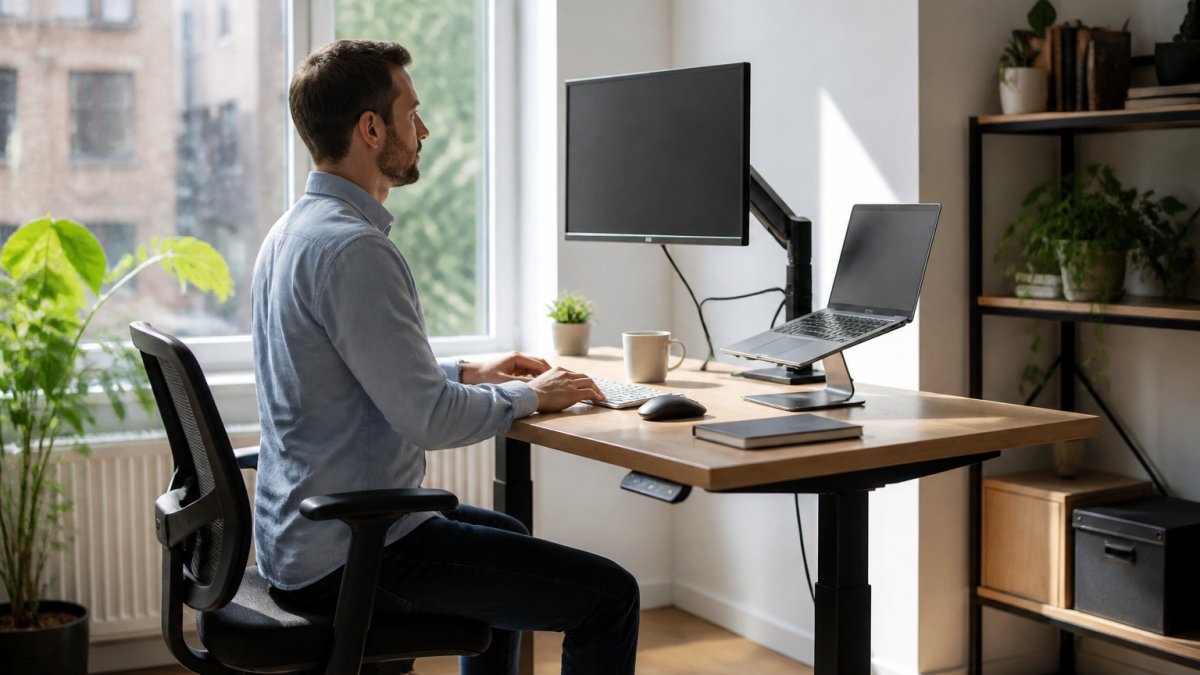
This guide from FRISKA DESK covers desk type, height range, stability, and budget. The desks compared below suit different home office setups, from a small flat to a dedicated study.
Quick Picks:
- Best Overall: Stockholm Signature Standing Desk, ideal balance of engineering, stability, and design for most professionals
- Best for Small Spaces: Primo Designer Standing Desk, compact footprint without sacrificing adjustability
- Best Budget Option: Ljungby Manual Hand Crank Standing Desk, genuine quality at entry-level pricing
- Best for Corner Offices: Stockholm Signature Corner Desk, maximises workspace in larger home offices
| Desk Model | Starting Price | Height Range | Load Capacity | Best For |
|---|---|---|---|---|
| Stockholm Signature | £665 | 595-1,300mm | 120kg | Most home office users |
| Primo Designer | £1,075 | 615-1,275mm | 100kg | Design-focused professionals |
| Ljungby Manual | £360 | 715-1,215mm | 80kg | Budget-conscious workers |
| Stockholm Corner | £1,165 | 595-1,300mm | 120kg | Large home offices |
| Aspa Executive | £1,295 | 680-1,170mm | 120kg | Premium workspace users |
Electric Standing Desk Models Compared
Electric desks dominate because they solve the friction problem. Manual adjustment requires effort every time you switch positions; electric motors remove that barrier. Users with electric desks alternate sitting and standing more frequently than manual desk owners, compounding the health benefits over months.

FRISKA DESK's electric models use Swedish-engineered dual motors. The Stockholm Signature at £665 delivers 120kg load capacity (including desktop) at a whisper-quiet operation, and raises or lowers at a speedy rate, fast enough that switching positions feels effortless.
The Primo Designer (£1,075) targets professionals who prioritise aesthetics, with an offset leg design, minimalist silhouette, and raw metal finish. The maximum load is 100kg. For anyone stacking monitors, the Stockholm's centred design and higher capacity make more sense.

The Aspa Executive (£1,295) sits at the premium end, using dual Linak motors and four robust legs. It's extremely stable at full height. Its height range compresses slightly (680-1,170mm), making it less suitable for very tall users or those who sit very low.
Standing Desk for Small Spaces: Space-Saving Solutions
The Primo Designer uses a narrower footprint, with offset legs. This can translate to real usable space behind the desk.
The Invik Mobile Micro-Workstation (£550) is a compact height-adjustable table on wheels (695-1,355mm range). It is highly manoeuvrable with four heavy duty castors enabling the user to change location with ease, complete with the benefit of wheel locking for safety. This mobile standing table is ideal for single user hot desking. The 60kg load limit works perfectly for a laptop and single screen.
For genuinely tight spaces, the Ljungby Manual (£360) excels. Its 690mm foot depth matches the Stockholm, but the manual crank means no motor housing underneath and more legroom when seated. The height range (715-1,215mm) covers most users. The tradeoff: you crank it by hand, which is fine occasionally but feels like work at three switches per day.
Best Sit-Stand Desk UK: What Sets Quality Desks Apart
Quality in standing desks divides into engineering, materials, and support. FRISKA DESK's desks, manufactured in Sweden with desktops finished in the UK, operate on a different standard.
Engineering shows in stability. At maximum height, the Stockholm Signature remains rock-solid thanks to 30% recycled steel, chunkier fixings, and tighter tolerances. Its dual motors synchronise perfectly to prevent tilt.
Materials matter because you spend eight hours per day at this desk. FRISKA desks use premium British timber with scratch-resistant melamine, so the desktop won't dent from a dropped pen or coffee cup. Eighteen finish options match your décor, from anthracite to warm oak.
Support separates good manufacturers from mediocre ones. FRISKA provides a 10-year guarantee covering motors and electrical components, and support is reactive: if your desk fails, you ring the UK team, they diagnose over phone or video, send a replacement part next day, and collect the faulty one.
According to ergonomic furniture research from the British Psychological Society, desk stability and ease of adjustment directly correlate with how frequently users actually alternate positions. Unstable desks and friction-heavy adjustment mechanisms discourage switching, which undermines the health benefits entirely.
Standing Desk Height Guide: Finding Your Perfect Fit
Height is the single most important specification. Get it wrong and you'll spend eight hours per day with your neck craned down or shoulders hunched up. The ideal sitting and standing heights are identical: elbows at 90 degrees with forearms parallel to the floor.
Most people fall into a predictable range. If you're between 5'4" and 6'2", the Stockholm Signature (595-1,300mm) covers your needs. The 595mm minimum suits wheelchair users and shorter professionals; the 1,300mm maximum accommodates anyone up to 2.1 metres tall.
The Primo Designer compresses this range slightly (615-1,275mm), losing 20mm at the bottom and 25mm at the top. For average-height users, this matters little. For very tall people or those who sit extremely low, the Stockholm is the safer choice.
The Aspa Executive (680-1,170mm) is the tightest range. It sacrifices low-end adjustability for premium stability at height. If you're over 6'4" or prefer to sit very low, this desk will frustrate you.
The Ljungby Manual (715-1,215mm) starts higher than electric models. If you're under 5'4" or over 6'2", it may not serve you as well; for average-height users, it works fine.
Stockholm Signature Standing Desk (with Bluetooth Control) →
Manual vs Electric: Which Desk Works for You
The manual-versus-electric choice divides on one question: how often will you actually adjust? If you never switch, the mechanism barely matters. If you switch three to five times daily, friction compounds into real time lost and skipped adjustments.
Research from occupational health guidelines published by the Health and Safety Executive recommends alternating positions every 30 minutes for optimal circulation and posture relief. At five switches per day, a manual crank means 2-3 minutes of cranking per day. Over a year, that's eight hours of cranking. Electric adjustment eliminates this entirely, switching takes two seconds.
The Ljungby Manual (£360) costs £305 less than the Stockholm Signature (£665), a real gap for budget-conscious buyers. But the trade-off isn't just convenience, it's whether you'll actually use the standing position.
Electric desks suit almost everyone else. The Stockholm Signature Bundle (£815) includes the desk, cable tray, memory controller, and cable ports. The memory controller saves two heights (sitting and standing) and switches between them with a single button press, removing the last friction point;
The Primo Designer (£1,075) and Aspa Executive (£1,295) are premium electric choices, both with Bluetooth app control for presetting heights or adjusting anti-collision sensitivity via smartphone. For most home office users, the Stockholm Signature offers better value: core functionality without paying for premium aesthetics or additional motor engineering.
Choosing Your Standing Desk: Budget, Space and Durability
The decision framework has three axes: budget, available space, and expected lifespan. They rarely align perfectly, so you're always trading something.
Budget-first buyers start with the Ljungby Manual (£360) or the Invik Mobile Workstation (£550), both genuine FRISKA quality at entry-level pricing. The Ljungby works for full-time use if you accept manual adjustment; the Invik works as a secondary standing surface or for hot-desking. Neither suits permanent all-day use as a primary desk if you want frequent switching.
Space-constrained buyers prioritise the Primo Designer (£1,075) or Invik (£550). The Primo's narrow footprint saves 100mm of depth versus the Stockholm, often the difference between a functional workspace and a cramped one. The Invik is the space-saving extreme: minimal floor area, wheeled away entirely when not in use.
Durability-focused buyers invest in the Stockholm Signature (£665) or Stockholm Signature Bundle (£815). The 10-year guarantee, Swedish engineering, and UK-finished desktops represent genuine long-term value: if you plan to use this desk for five to ten years, it pays for itself through reliability alone, while cheaper desks typically fail within three to four years.
According to consumer durability research from Which? magazine, furniture lifespan correlates directly with frame engineering and motor quality. FRISKA desks consistently outlast budget alternatives by 2-3 years, which amortises the premium price across a longer service life.
The Stockholm Signature Corner Desk (£1,165) or Corner Bundle (£1,295) adds a third axis: workspace. Corner desks nearly double usable surface area, ideal for professionals juggling multiple monitors, reference materials, or client video calls. The trade-off is footprint: corner desks occupy 2.5-3 square metres rather than 1.5-2. They're only practical in rooms with genuine corner space available.
The Aspa Executive (£1,295) is the premium choice for professionals who value stability and aesthetics equally. Its four-leg design and premium motor engineering make it the most stable desk at full height, and its minimalist frame the most visually striking. For executive home offices or client-facing video calls, the Aspa justifies its premium price.
The standing desk for home office you choose depends on what you'll actually use. The best desk is the one you'll adjust frequently, not the one with the most features gathering dust at maximum height. FRISKA DESK's range covers every realistic scenario, from the budget-conscious Ljungby to the premium Aspa.
The challenge with standing desks isn't finding one, it's committing to actually using it. Many buyers invest in a desk, then default to sitting because adjustment feels like friction. FRISKA DESK addresses this with memory controls, Bluetooth app adjustment, and whisper-quiet motors that make switching positions effortless. Get started with the Stockholm Signature Standing Desk and experience the difference genuine engineering and 10-year support make.

Frequently Asked Questions
What height should a standing desk be for proper ergonomics?
Your standing desk should position your elbows at roughly 90 degrees when your arms hang naturally at your sides. Most standing desks adjust from around 595 mm (ideal for wheelchair users and shorter individuals) to 1,300 mm (suitable for people up to 2.1 metres tall). The best standing desk for home office use offers a wide height range so you can alternate comfortably between sitting and standing throughout the day.
Are electric standing desks better than manual ones?
Electric standing desks offer convenience, especially if you adjust frequently throughout the day. They're quieter, faster, and require minimal effort. Manual hand-crank desks like the Ljungby at £360 work well if you adjust height less often or have budget constraints. For most home office professionals, an electric standing desk delivers better long-term value because you're more likely to use it regularly when switching positions is effortless.
Can a standing desk actually help with back pain?
Standing desks can improve posture and reduce strain when used correctly, but they're not a cure for chronic back pain. The key is alternating between sitting and standing throughout the day rather than standing all day. Pair your desk with proper monitor height (using a monitor arm), an anti-fatigue mat like the Nyborg, and regular movement breaks. Many users report relief from shoulder and lower back discomfort after switching to a quality adjustable desk.
What size standing desk is best for a home office?
For most home offices, a desk 120 cm to 160 cm wide provides enough space for a monitor, keyboard, and work materials without overwhelming the room. If you have limited space, corner desks maximise your layout, whilst the mobile Invik workstation at £550 works in compact flats. Consider your depth too: 60-80 cm is standard, but ensure you have legroom when seated and can stand comfortably without hitting walls or furniture.
How much should I spend on a quality standing desk for home use?
Quality standing desks range from £360 for a manual option to £1,295 for premium designer models. For most remote workers, investing £665-£815 in an electric desk like the Stockholm Signature offers excellent stability, a 10-year guarantee, and features like Bluetooth control. The premium justifies itself through durability, support quality, and the health benefits of consistent use over several years.