


Last Updated: November 5, 2026
Quick Summary
Bamboo vs oak for a daily-use standing desk: bamboo is the lower-risk choice in humid or variable rooms because its pressed construction stays dimensionally stable, while solid oak is harder to refinish but can be sanded back and rewards proper bracing. Choose bamboo for stability and lower cost, or oak for character and repairability.
- Dense strand-woven bamboo resists pen marks and knocks well, but is hard to refinish once deeply damaged.
- The Character Oak desktop is 26mm thick with inset metal battens and costs £415.83.
- Slight distortion, warping, bowing or splitting of up to 2mm in solid oak is not considered a faulty product.
- A desktop sags when the span between frame supports is too wide for its thickness and stiffness.
- Order free desktop samples to compare bamboo and oak surfaces against your room and lighting.
Table of Contents
- Bamboo vs Oak Standing Desk: A Direct Comparison for Daily Use
- Bamboo vs Solid Wood Desk: Strength, Hardness and Load-Bearing Capacity
- Bamboo Standing Desk Durability: Scratches, Dents and Everyday Wear
- Surface Stability, Warping and Sagging Over Years of Use
- Finishes, Construction and What They Mean for Product Quality
- Best Wood for a Standing Desk: Sustainability, Cost and Whole-Desk Fit
- Care, Repair and Damage Recovery for Bamboo and Oak Tops
- Choosing Your FRISKA DESK Desktop and Frame Combination
- Frequently Asked Questions
Bamboo vs Oak Standing Desk: A Direct Comparison for Daily Use
Choosing between bamboo and oak for a standing desk comes down to one practical question: which surface will still look good and feel solid after years of daily raising, lowering and working? This guide from FRISKA DESK compares the two materials on strength, wear, stability, finish and cost.
Bamboo is a grass-based material made from strips or strands bonded under pressure into a dense board. Oak is a hardwood cut from solid timber, either as planks or engineered into a stable core. Both make excellent desktops. They simply fail in different ways, and knowing which failures matter to you is the whole decision.
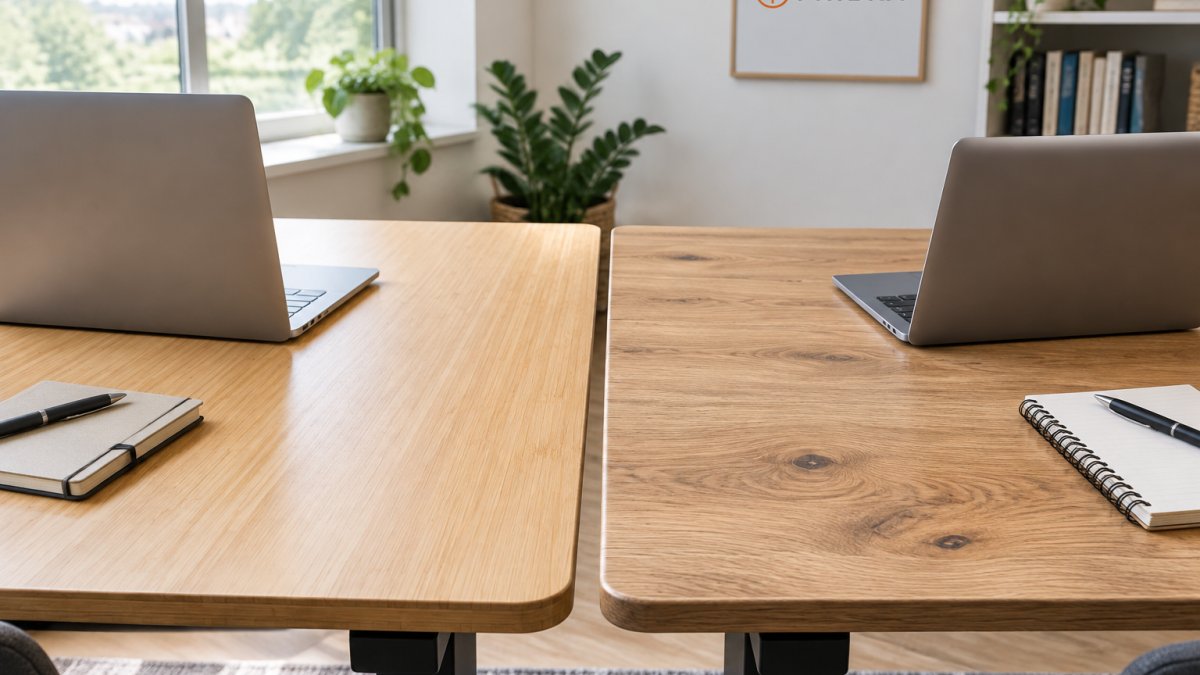
How the Two Materials Are Built
Oak desktops come as solid planked timber or engineered wood with an oak veneer over a stable core. Solid oak shows knots, colour variation and full grain depth. Engineered oak gives a similar look with less movement.
Construction method matters more than the species name. A well-braced solid oak top and a poorly pressed bamboo top are not equals, so ask how the board is made before judging the material.
Head-to-Head at a Glance
| Factor | Bamboo | Oak |
|---|---|---|
| Material type | Pressed grass, strand-woven | Hardwood, solid or engineered |
| Hardness | Very hard, dense surface | Hard, slightly softer than dense bamboo |
| Moisture behaviour | Stable when sealed | Moves with humidity, needs bracing |
| Appearance | Uniform, fine grain | Knots, character, deep grain |
| Repair | Hard to refinish deeply | Sandable and refinishable |
| Relative cost | Generally lower | Higher, especially solid |
Bamboo vs Solid Wood Desk: Strength, Hardness and Load-Bearing Capacity
Hardness is how well a surface resists a pointed or sharp object. Dense strand-woven bamboo is famously hard, resisting pen marks and knocks well. Oak is also hard, but solid oak will dent if something heavy is dropped on it.
Load-bearing capacity is mostly about the frame and bracing, not the species. A 26mm solid oak top with inset metal battens spreads weight and resists bowing.
For heavy monitors, dual arms and clamp-mounted accessories, check the desktop thickness and the frame rating together. A strong top on an undersized frame still flexes.
Bamboo Standing Desk Durability: Scratches, Dents and Everyday Wear
Bamboo standing desk durability holds up well against scratches and ink, but it is harder to refinish once deeply damaged. Oak takes everyday wear gracefully and can be sanded back.
Daily use means mugs, keys, notebook edges, a mouse and the occasional dropped phone. Dense bamboo shrugs most of this off, resisting the small scratches that build up on softer timbers.
Oak develops small marks, and many owners like that patina. The advantage is that a solid oak top can be sanded and re-lacquered to look new again, while a deep gouge in bamboo is difficult to disguise.
Watch out: solid wood tops can distort, bow or split by up to 2mm, and that is not treated as a fault. If tiny movement would bother you, an engineered top removes the worry.
Surface Stability, Warping and Sagging Over Years of Use
Surface stability is where bamboo and oak diverge most in daily use. Bamboo's pressed construction makes it dimensionally stable, while solid oak moves with seasonal humidity and needs proper bracing to stay flat. Both can sag if the frame span is too wide for the top's thickness.
Bamboo desktops are strand-woven or strip-pressed under high pressure, which removes most internal stresses found in natural timber. The result resists the seasonal swelling and shrinking of solid wood, so a well-sealed bamboo top holds its shape in fluctuating humidity. The trade-off is that bamboo's hardness leaves little give if the board does distort. Because even a stable bamboo top depends on a sound seal, the same care involved in maintaining wood office furniture helps protect its surface as humidity changes.
Solid oak can move with humidity. The Character Oak desktop is 26mm thick with inset metal battens on the underside to give structural strength, and slight distortion, warping, bowing or splitting of up to 2mm is not considered a faulty product.
Sagging is a frame problem as much as a top problem. A desktop sags when the span between frame supports is too wide for its thickness and stiffness. Bamboo's uniform density resists sagging across a span, but it will still bow if the frame is undersized. Oak's grain direction matters: planks running lengthways are stiffer across the width than crossways planks, so check the construction before assuming a solid top is automatically stronger.
Watch out: buyers often upgrade to a thicker top without checking the frame's load rating or support spacing. A heavy top on a frame with wide spans will flex more than a lighter top on a well-braced frame. Check the top's thickness and weight against the frame's rated load before buying.
Character Oak Solid Desktops →
For daily use, bamboo is the lower-risk choice in humid or variable rooms, while solid oak rewards proper bracing and a stable indoor environment. Engineered oak tops remove most of the movement worry but lose the solid-timber repairability, the sensible middle ground if you want the oak look with fewer stability concerns.
Finishes, Construction and What They Mean for Product Quality
Finish quality separates a desk that lasts from one that disappoints. A matt lacquer on oak seals the grain and gives a smooth touch, while bamboo relies on a hard factory finish to protect the pressed surface.
Construction details to check:
- Thickness: 26mm solid tops feel substantial and resist flex.
- Bracing: metal battens underneath keep natural wood flat.
- Edge finish: hand-finished edges on solid wood look better and resist chipping.
- Core quality: engineered and MFC tops use stable cores that resist movement.
- Surface protection: a proper lacquer or hard melamine finish decides how well the top ages.
One practical step before buying is to see the finish in person. Order free desktop samples to compare bamboo and oak surfaces against your room and lighting before committing.

Best Wood for a Standing Desk: Sustainability, Cost and Whole-Desk Fit
The best wood for a standing desk depends on whether you value renewability or longevity most.
Cost follows the same logic.
Whole-desk fit matters too. The top must match the frame's width, depth and fixing points. If you are still weighing brands and builds, this head-to-head standing desk review is a useful benchmark before you settle on a material.
Care, Repair and Damage Recovery for Bamboo and Oak Tops
Routine care for both. Clean spills at once, liquid left sitting can stain, discolour and, on solid oak, cause localised swelling. For practical guidance on protecting or restoring a solid wood top, see how to seal a solid wood desk top. Use coasters under hot mugs and a mat under anything that might scratch.
Choosing Your FRISKA DESK Desktop and Frame Combination
The material choice is only half the decision; the other half is pairing the right top with the right frame. FRISKA DESK builds Swedish-engineered standing desks around premium British timber, with bespoke sizes available and a 10-year guarantee on its MFC desktops.
If oak is your pick, the Character Oak solid desktop is 26mm of solid oak with natural knots, black-filled imperfections on the topside and inset metal battens on the underside for strength, finished in matt lacquer at £415.83. It suits the buyer who wants real wood character and accepts that slight distortion, warping or splitting of up to 2mm is part of the deal.

Once the top is chosen, browse height-adjustable desk frames to complete a standing desk matched to your space and load. The frame decides stability and lift; the top decides how the desk looks and wears.
For anyone weighing bamboo against oak for daily use, the honest answer is that both work. Match the material to how you actually work, then build the desk around it.
Frequently Asked Questions
Is bamboo or oak better for a standing desk?
FRISKA's solid oak desktops are made from solid wood with a natural grain and inset metal battens on the underside for structural strength. Choosing between materials depends on how you work and the look you prefer.
Which is more durable for daily use, bamboo or oak?
FRISKA's Character Oak desktops are 26mm thick and include inset metal battens on the underside to give structural strength. Slight distortion, warping, bowing or splitting of up to 2mm is not considered a faulty product.
Does a bamboo desk scratch more easily than an oak desk?
Bamboo is harder than many people expect, and quality strand-woven bamboo can rival oak on scratch resistance. The difference is recovery: a scratch on a lacquered oak top can often be sanded and re-lacquered, while a scratch on bamboo is harder to blend because the laminate layers show. For either material, use a desk mat under keyboards and monitors and wipe spills promptly to protect the finish.
How do you care for a bamboo standing desk?
Wipe the surface with a mildly soapy warm cloth and dry it immediately with a dry cloth. Avoid antibacterial and household cleaning sprays, which can attack the finish and leave a sticky feel. Keep liquids off the surface, use a coaster under drinks and a mat under heavy equipment, and check the frame fixings every few months. A protective coating or lacquer will need reapplication over time depending on use.
Is an oak standing desk worth the extra cost?
FRISKA's Character Oak Solid Desktops are priced at £415.83 for the desktop alone, with a 5-year guarantee and inset metal battens for structural strength. Order a solid wood sample for £10 to compare the finish against your décor before committing.
The real test of a standing desk is whether it still feels solid and looks good after a few years of daily raising and lowering. FRISKA DESK pairs Swedish engineering with premium British timber, backs its desks with a 10-year guarantee, and offers bespoke sizes plus free next-day delivery to mainland UK. Get started with FRISKA DESK and build a workspace that supports better posture and circulation for the long term.
