


Last Updated: 14 November 2026
Quick Summary
The best desk top material for a home office depends on your priorities: braced solid wood or plywood for stiffness on long spans, and MFC or laminate where scratch and spill resistance matters most. Match the desk top to your frame's rated load and your desk's span before choosing a finish.
- Solid wood can be sanded and refinished, while MDF relies on its factory finish for life.
- Under a 1,400mm span, a 25mm top is usually fine on a braced frame.
- Over 1,800mm, add a central leg or cross brace whatever the material.
- Solid timber tops are not pre-drilled with metal screw inserts, so pilot holes are needed.
- Solid wood desktop samples cost £10.00, refunded against your order.
Table of Contents
- How to Judge a Desk Top Material Before You Buy
- Solid Wood vs MDF Desk Top: The Core Trade-Off
- The Best Wood for a Desk Top: Oak, Walnut and Reclaimed Timber
- Plywood, MFC and Laminate: Engineered Desk Top Options
- Desk Top Thickness, Strength and Sagging Under Load
- Choosing a Standing Desk Top Material for Your Frame
- Durability, Care and Long-Term Repair by Material
- Order a Desk Top Sample Before You Commit
- Frequently Asked Questions
How to Judge a Desk Top Material Before You Buy
The best desktop material for a home office desk balances stiffness, weight, finish and cost against how you actually work. FRISKA DESK sees the same pattern in most home office enquiries: buyers focus on colour and grain first, then discover that thickness, stability and moisture resistance decide whether a desk top still looks good after five years.
Judging a desk top comes down to four tests. How much does it deflect under a monitor and your forearms? How well does the surface resist scratches, ink and spills? How heavy is it, and will your desk frame carry it? And can it be repaired, or does damage mean replacement? Aesthetics matter, but they are the last filter, not the first.
Most guides compare two or three materials and leave you to guess the rest. The table below puts solid wood, plywood, MDF, melamine-faced chipboard (MFC), veneer and laminate against the same criteria, so you can see the trade-offs in one place.
| Material | Stiffness and sag resistance | Surface resistance | Weight (approx. kg/m² at 25mm) | Repairability | Moisture behaviour | Typical cost band |
|---|---|---|---|---|---|---|
| Solid oak | High when braced; can bow without battens | Good; refinishable | 15-18 | Excellent: sand and re-lacquer | Moves with humidity; seal all faces | ££££ |
| Solid walnut | High when braced; similar to oak | Good; refinishable | 14-17 | Excellent | Moves with humidity; seal all faces | £££££ |
| Reclaimed pine | Moderate; needs bracing on long spans | Moderate; softens under dents | 12-15 | Excellent: sand and re-oil | Moves; existing cracks need filling | £££ |
| Plywood (birch-faced) | High for its weight; good screw-holding | Moderate; depends on finish | 11-14 | Fair: localised patching only | Edges swell if unsealed | ££ |
| MDF | High and flat; heavy | Good with factory finish | 18-22 | Poor: replace rather than refinish | Swells at unsealed edges | ££ |
| MFC (melamine-faced chipboard) | Moderate; chipboard core is less stiff | Very good: scratch and ink resistant | 16-20 | Poor: chips cannot be blended | Core swells if water reaches edges | £ |
| Laminate (e.g. Formica) | Moderate to high depending on core | Excellent: hard wear layer | 16-21 | Poor: visible chips | Good if edges are sealed | ££ |
| Veneer on stable core | High; core dictates stiffness | Good but thin wear layer | 14-18 | Poor to fair: patching shows | Good if edges are sealed | £££ |
Weight (approx. kg/m² at 25mm)
Read the table by use case rather than by material prestige. A heavy triple-monitor setup on a 1,800mm span needs stiffness first, which points to braced solid timber, plywood or a thick engineered top. A shared desk that takes daily coffee spills and ink marks favours MFC or laminate, where the surface resists damage and the cost of replacement is low. A writing desk that you want to hand down favours solid oak, because it can be sanded back rather than replaced.
Below, this guide compares each material in turn on the same criteria, so you can match material to budget and use rather than guess from a showroom photo.
Solid Wood vs MDF Desk Top: The Core Trade-Off
Solid wood can be sanded back and refinished after years of use, while MDF relies on its factory finish for its entire life.
MDF, or medium-density fibreboard, is a composite of fine wood fibres pressed with resin into dense, uniform panels. It machines cleanly and stays flat, but it swells if water reaches an unsealed edge.
Solid wood moves with humidity. A common mistake is assuming a thick timber top cannot warp; without bracing, it can. Inset metal battens on the underside of a solid top add structural strength to the planks.
The Best Wood for a Desk Top: Oak, Walnut and Reclaimed Timber
Oak is a popular choice for a desk top when properly braced. Walnut offers a darker grain, while reclaimed timber brings a vintage character.
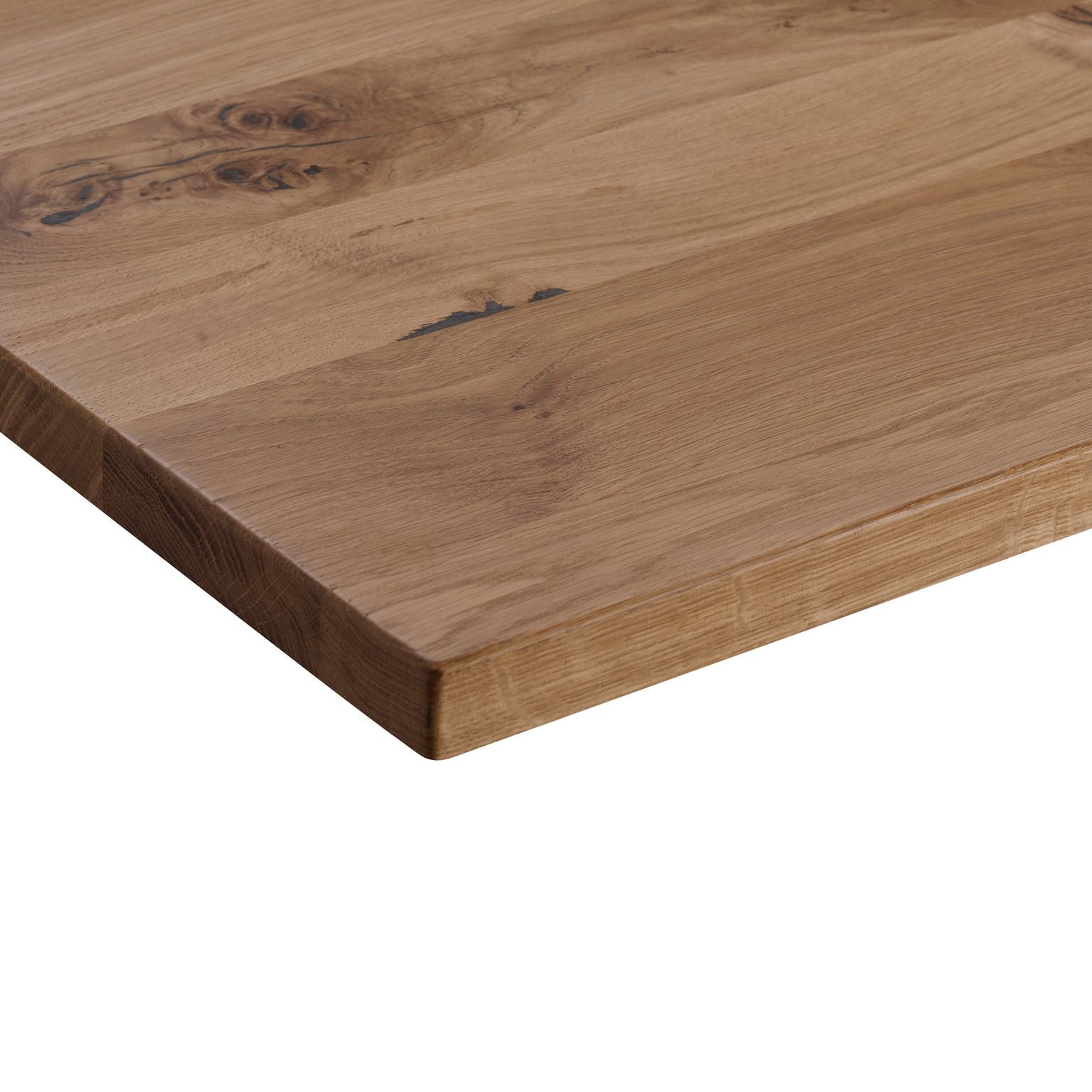
The Character Oak Solid Desktops are solid oak with natural knots, filled cracks and a matt lacquer finish, priced at £415.83. For a vintage look, the Reclaimed Scaffold Board Desktops use genuine scaffold planks, priced at £315.00, with wear marks preserved under matt lacquer.
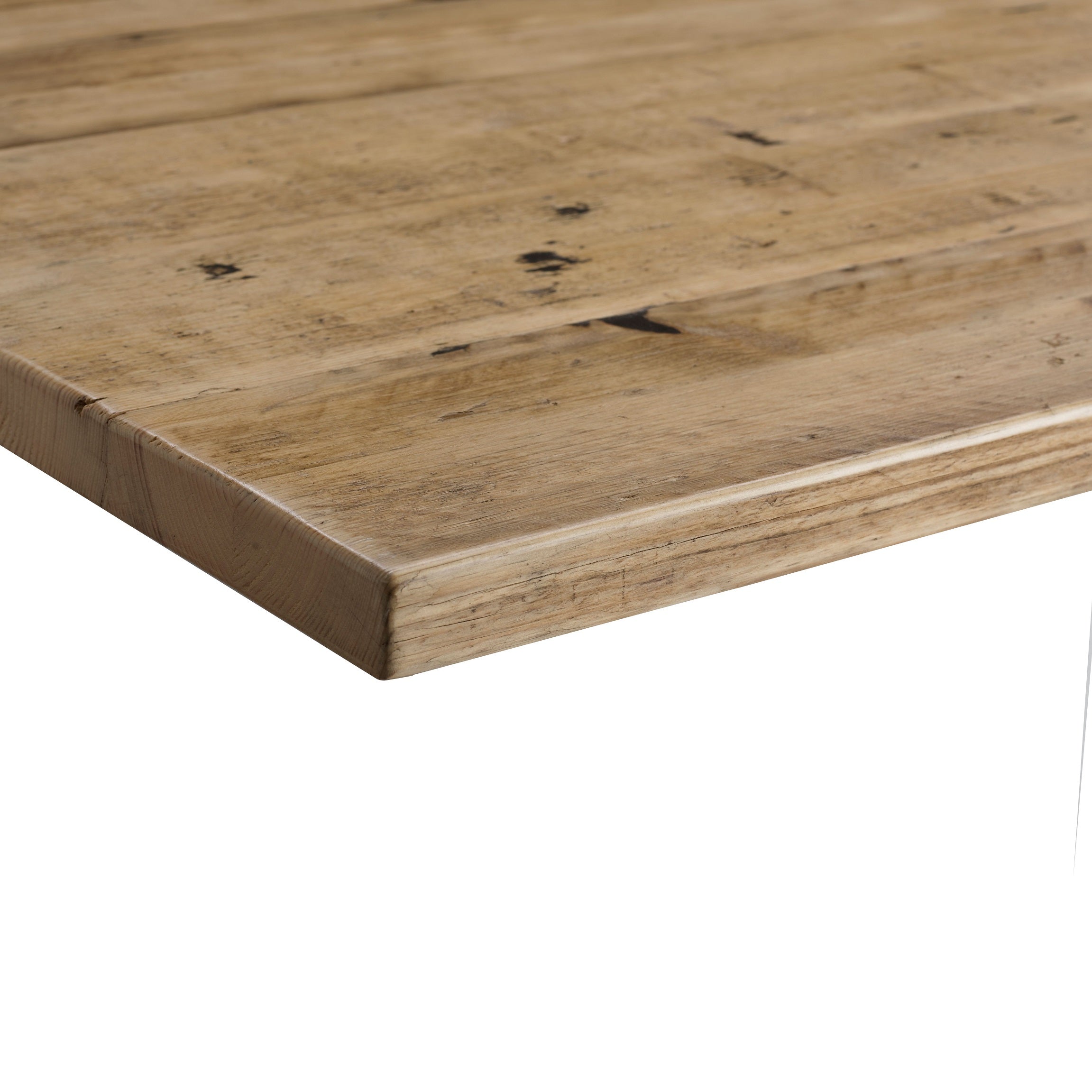
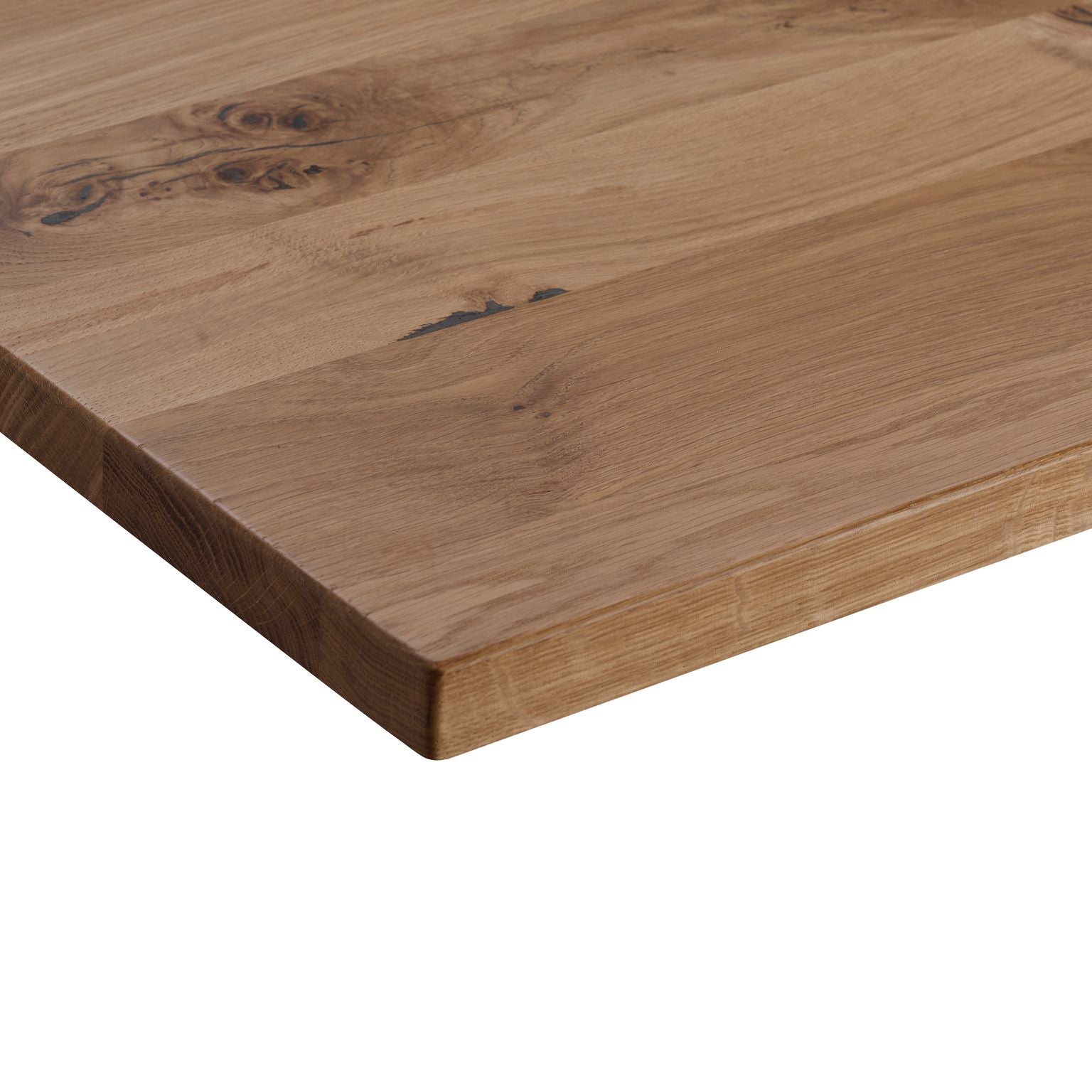
Natural timber can bow or split by up to 2mm, which is not classed as a fault. If that bothers you, the engineered tops may suit you better.
Plywood, MFC and Laminate: Engineered Desk Top Options
Engineered boards give you a flatter, more predictable desk surface at a lower price. Plywood layers veneers at right angles for good screw-holding and stiffness. MFC, or melamine-faced chipboard, wraps a chipboard core in a hard melamine skin. Laminate such as Formica bonds a decorative sheet to a core for strong scratch and moisture resistance.
Veneer sits between the two worlds: real wood sliced thin and glued to a stable core, so you get genuine grain without solid timber's movement. The trade-off is thin wear layers. Once a veneer or laminate surface chips, repair is difficult and usually visible.
FRISKA DESK's MFC finishes use EGGER boards with an antibacterial surface tested to ISO 22196.
Desk Top Thickness, Strength and Sagging Under Load
Load capacity is a frame question as much as a top question. A heavy solid timber top steadies a standing desk at height, but it also eats into the motor's rated load. Check both figures before pairing them.
- Under 1,400mm span: 25mm is usually fine
- 1,400mm to 1,800mm: 26mm to 33mm with bracing
- Over 1,800mm: add a central leg or cross brace
Choosing a Standing Desk Top Material for Your Frame
For a standing desk, the top material must suit the frame's lifting capacity and the desk's stability at full height. Heavier tops improve stability when raised but reduce the payload left for monitors and equipment. Lighter engineered tops raise more weight but can feel less planted.
Start with the frame's rated load, then subtract the top's weight.
Thickness and span interact with the frame. Most sit-stand frames accept tops from 25mm to 30mm without modification, and the frame's crossbar or side brackets set the maximum span before sag becomes visible. As a working guide:
- Under 1,400mm span: 25mm is usually fine on a braced frame
- 1,400mm to 1,800mm: 26mm to 33mm with bracing or a central support
- Over 1,800mm: add a central leg or cross brace, whatever the material
Fixing methods differ by material and catch out DIY builds. Solid timber tops are not supplied pre-drilled with metal screw inserts because the wood limits CNC machining. That means a DIY build with a solid top needs pilot holes, a depth stop and a little patience, driving a screw too close to an edge splits timber but merely strips chipboard.
Dimensions affect usable space as much as stability. A 1,600 x 800mm top gives room for two monitors and a keyboard with forearms supported; a 1,400 x 700mm top suits a single screen and a notebook but feels cramped once a printer or lamp joins.
Cable management is easier to plan before the top arrives. Route cables before the frame goes on, not after.
A common mistake is buying the top last. Choose the frame's load rating first, then pick a material whose weight leaves headroom for your screens. If you are unsure, order a sample to judge finish and ask the frame supplier for the top's exact weight before committing.
Durability, Care and Long-Term Repair by Material
Melamine and laminate resist scratches and spills but cannot be refinished. Solid oak and reclaimed timber can be sanded and re-lacquered.
For a full routine, see how to seal a solid wood desk top so it lasts. Expect to re-oil or re-lacquer solid timber periodically, and expect composites to be replaced rather than repaired if the surface fails.
Order a Desk Top Sample Before You Commit
Order a physical piece, place it beside your décor, and judge the finish in daylight before spending on a full top.
FRISKA DESK makes this easy. Solid wood desktop samples are 150 x 100mm for £10.00, refunded against your order, and free desktop samples cover MFC finishes at no cost with no obligation.
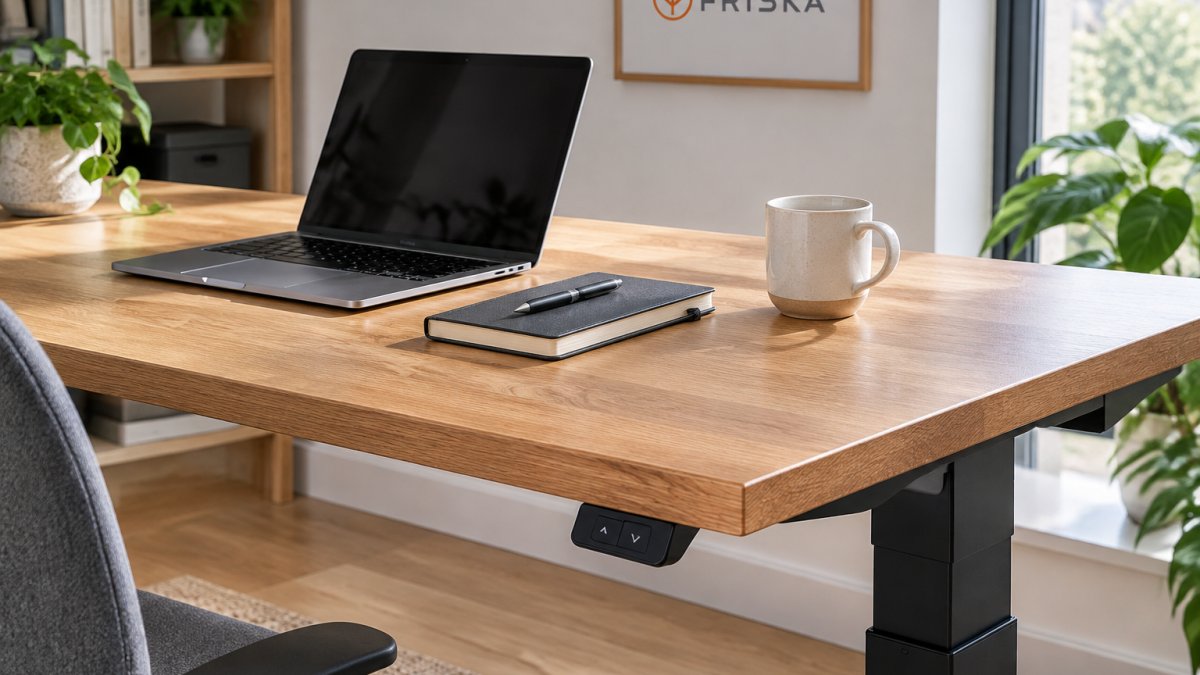
Matching a desk top to your frame, your load and your care habits is the difference between a surface that lasts and one you replace. FRISKA DESK builds Swedish-engineered standing desks around premium British timber, with bespoke sizes, free next-day delivery to mainland UK, a 10-year guarantee and award-winning support. Order a sample, confirm your finish, and get started with FRISKA DESK to build a desk that supports better posture and circulation for years.
Frequently Asked Questions
What is the best material for a home office desk top?
There is no single winner because it depends on how you use the desk. Solid wood, such as the Character Oak Solid Desktops at £415.83, gives the best appearance and can be refinished if it marks. MFC and laminate are the most resistant to spills and scratches and cost the least. Plywood sits in the middle on cost and strength. If the desk is in daily use for eight hours, prioritise wear resistance and stability over looks.
Is solid wood better than MDF for a desk?
Solid wood wins on appearance, repairability and resale value, but it moves with humidity and can warp or split slightly, which is why braced tops are used. For a desk you plan to keep for a decade and possibly sand back, solid wood is the better buy. For a low-cost, low-maintenance desk, MDF or MFC is more practical.
How thick should a wooden desk top be?
Most home office desk tops sit between 25mm and 33mm. The Character Oak Solid Desktops are 26mm thick and the Reclaimed Scaffold Board Desktops are around 33mm. Thicker tops add weight, which matters on a height-adjustable frame.
Does a standing desk need a particular type of desk top material?
Weight and stability matter most on a standing desk. A heavy solid timber top adds weight to the frame, so check the frame's load capacity. MFC tops are lighter and easier to lift. Whichever standing desk top material you pick, make sure it is flat, at least 25mm thick and has fixings that suit your frame, since some solid wood tops are not pre-drilled.
